The Real Price Tag: Why Cheap Bags Are Actually the Most Expensive Ones You Own
Let's do a little math that nobody warned you about in personal finance class.
You spot a bag at a fast-fashion retailer. It's $38, it's cute, it looks almost exactly like the $380 version you've been eyeing for six months. You grab it. Smart, right? Maybe not.
Because here's what that $38 actually buys you: roughly eight to fourteen months of use before the zipper starts catching, the lining peels, the strap frays, or the hardware turns a suspicious shade of green. Then you replace it. And again. And again. Over five years, you've spent somewhere between $150 and $230 on the same bag — just in cheaper, worse versions. Meanwhile, the $380 investment piece is still going strong and has, at this point, cost you less per carry than a cup of airport coffee.
This is what we call the bag tax. And almost every budget-minded shopper is paying it without realizing it.
The Replacement Cycle Nobody Talks About
Fast-fashion bags are engineered with a shelf life. That's not cynicism — it's business model. The materials are thinner, the hardware is decorative rather than functional, and the construction shortcuts that keep costs low also accelerate wear. A bonded leather bag, for example, can start delaminating within a year of regular use. A canvas tote with cheap screen printing fades and cracks within a season. These aren't defects. They're features of a product category designed to be replaced.
Investment bags, by contrast, are built on a completely different logic. Full-grain leather develops a patina rather than falling apart. Solid brass hardware doesn't corrode. Reinforced stitching at stress points — handles, strap attachments, zipper ends — means the bag survives the abuse of daily life instead of succumbing to it.
The numbers back this up. According to secondhand market data, well-made leather bags from mid-to-high-tier brands retain between 40 and 70 percent of their original value after five years of use. Fast-fashion bags retain essentially zero — and most end up in landfills.
The Repair Cost Equation
Here's a variable most people forget to factor in: repair.
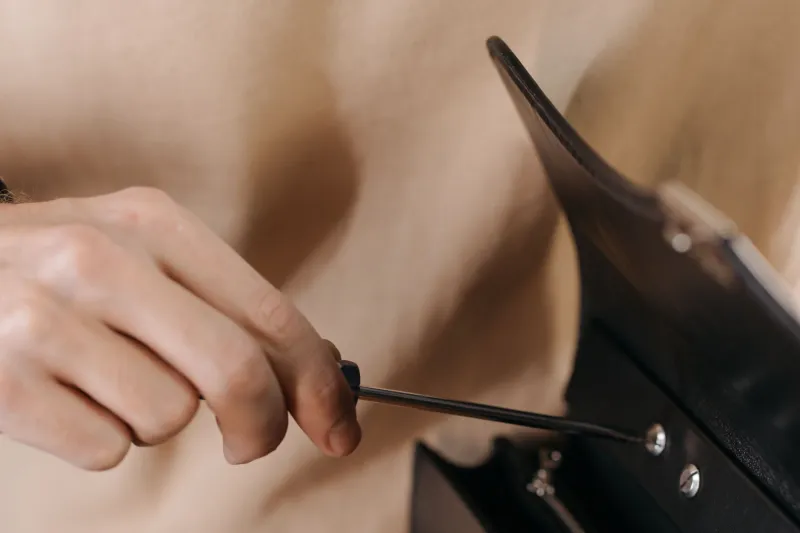
A quality bag is worth repairing. A cobbler can replace a worn strap, re-stitch a handle, or swap out tarnished hardware for anywhere from $20 to $80 depending on the job. That same repair extends the bag's life by years, making the per-use cost even lower. You can find leather repair services in almost every mid-sized American city, and mail-in options like Leather Spa have made it accessible nationwide.
A cheap bag, on the other hand, isn't worth repairing — and usually can't be. When the faux leather starts peeling or the plastic buckle snaps, there's no fixing it. The bag becomes trash. The money you spent becomes a sunk cost. And the cycle starts over.
This repair calculus is one of the most overlooked arguments for quality. When you buy a bag that can be fixed, you're not just buying a product — you're buying a relationship with an object that can outlast trends, moves, jobs, and decades.
The Environmental and Ethical Price You Don't See on the Tag
Beyond your personal wallet, there's a broader cost embedded in every cheap bag that never shows up at checkout.
Fast-fashion accessories are largely produced in facilities with minimal environmental oversight. The synthetic materials — PVC, bonded leather, low-grade polyester — are petroleum-based and non-biodegradable. When these bags end up in landfills (and they do, at staggering rates), they don't break down. The EPA estimates that Americans throw away over 11 million tons of textiles and accessories annually, and bags are a meaningful contributor.
Labor conditions in fast-fashion supply chains are also well-documented as problematic. While not universal, the pressure to produce at rock-bottom prices frequently translates to suppressed wages and unsafe conditions for workers — predominantly women — in manufacturing countries.
None of this means every expensive bag is ethically spotless. But it does mean the $38 price tag has externalities that real people and real ecosystems are absorbing on your behalf. That's a cost worth knowing about.
What "Investment" Actually Means at Different Price Points
Let's be clear: investing in a quality bag doesn't require a four-figure budget.
The sweet spot for American shoppers who want durability without designer markup tends to fall in the $150–$400 range for new bags, with even better value available in the secondhand market. Brands like Cuyana, Madewell, Lo & Sons, and Dagne Dover consistently land in this zone and use materials and construction methods that are built to last.
The key isn't the brand name — it's the construction details. Look for:
- Full-grain or top-grain leather rather than bonded leather or PU
- YKK or equivalent zippers (they're the standard for a reason)
- Metal hardware with weight and solidity, not lightweight plastic with a metallic finish
- Reinforced stitching at every stress point
- A structured or reinforced base so the bag holds its shape under load
If a bag has all of these and costs $180, it's almost certainly a better financial decision than a $50 bag that has none of them.
Running the Numbers for Yourself
Here's a simple exercise worth doing before your next bag purchase.
Take the price of the bag you're considering and divide it by the number of times you realistically expect to carry it. A $40 bag you replace every year and carry 150 times costs you about $0.27 per use. A $280 bag you carry for seven years — 500+ times — costs you less than $0.56 per use before you account for the fact that it still has resale value. Factor that in, and the math gets even more favorable.
Now add in the two or three replacement purchases you won't have to make, the repair visits that extend its life, and the environmental cost of not sending three bags to the landfill. The cheap bag doesn't look cheap anymore.
The Mindset Shift That Changes Everything
The bag tax isn't just a financial phenomenon — it's a psychological one. Fast-fashion pricing is designed to feel low-risk. At $38, the stakes seem minimal. But that low-risk feeling is exactly what keeps the cycle going, purchase after purchase, year after year.
Shifting to an investment mindset doesn't mean spending more overall. For most people, it means spending the same amount — or less — but concentrating it differently. One great bag instead of four mediocre ones. A purchase you research instead of one you impulse-grab. A piece you care for instead of one you tolerate until it falls apart.
The bags that carry you through life — the ones that show up in photos, travel across time zones, get passed down — aren't the cheap ones. They never were.